Roughly in December 2034, NASA’s Dragonfly mission will send a nuclear-powered rotorcraft to Titan, Saturn’s largest moon, creating an opportunity to send a flying planetary laboratory to another world.
Titan is exceedingly strange but also scientifically valuable.
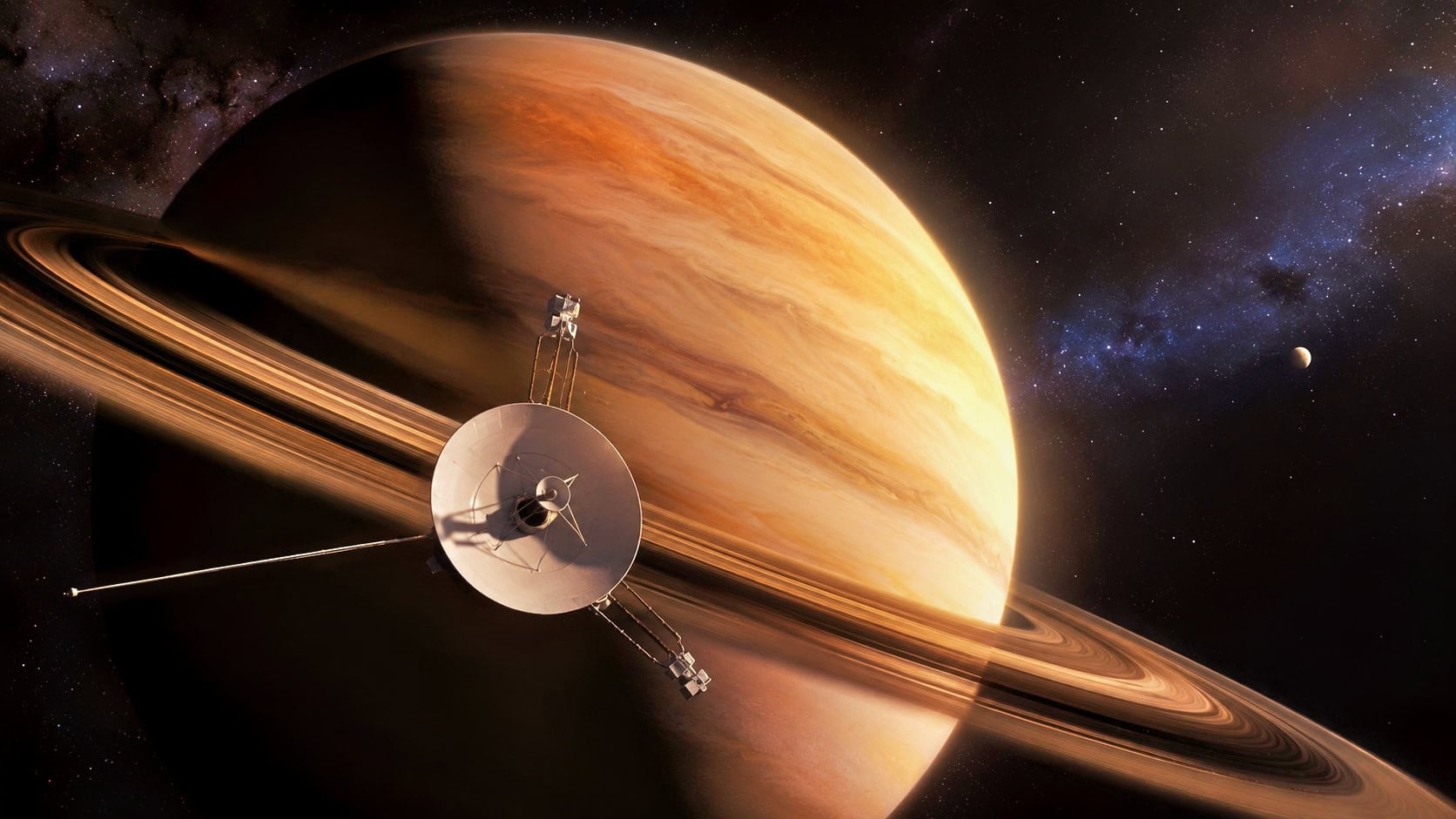
Pioneer 11 Probe NASA and Saturn Artist Rendering. Image Credit: Banana Nano.
It has a dense nitrogen-rich atmosphere, surface temperatures around -290°F, and features clouds, rain, rivers, and lakes—all involving methane and ethane rather than water.
Titan also has enormous quantities of complex, carbon-rich organic material. The Dragonfly mission won’t be headed to Titan to look for alien organisms; instead, the objectives will be oriented toward chemistry rather than biology.
NASA will lead the mission, but it will be an international affair, with ESA researchers contributing—marking another example of cooperation in interplanetary exploration, a stark departure from the era of the “space race.”
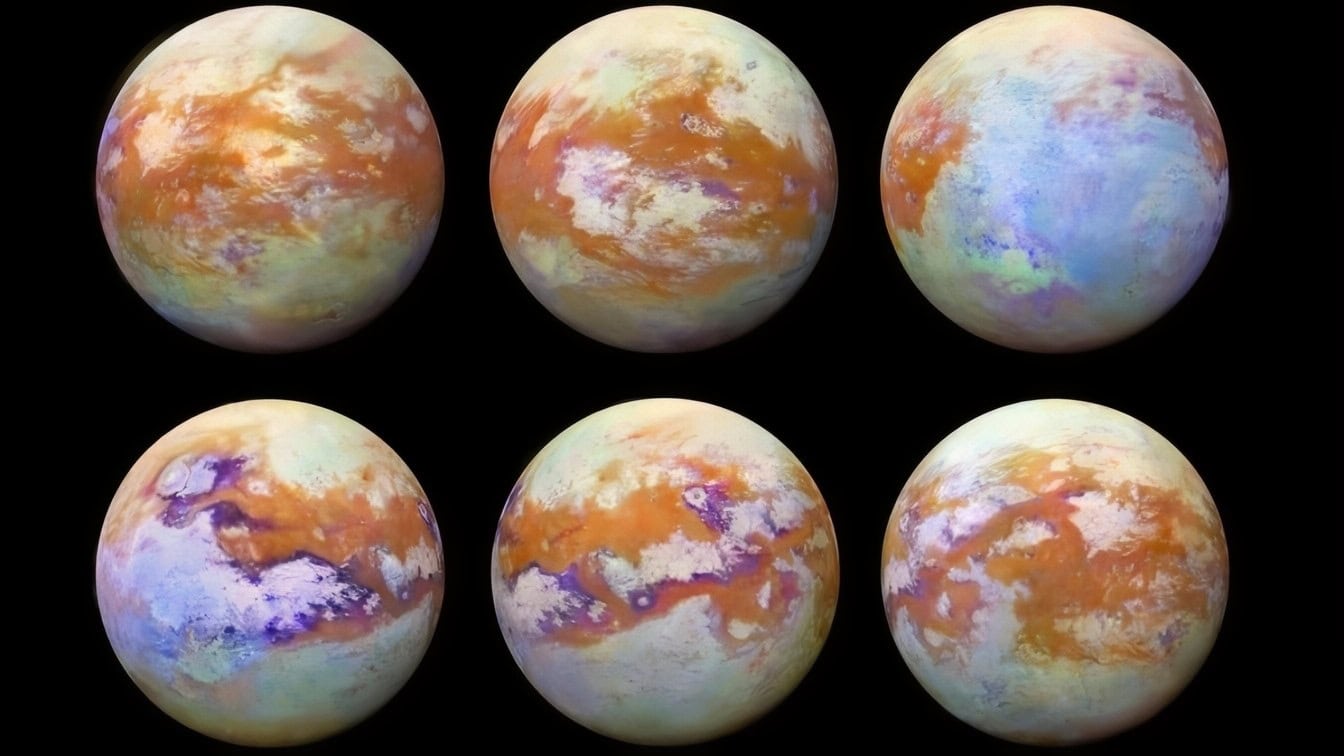
Titan NASA Photo Montage
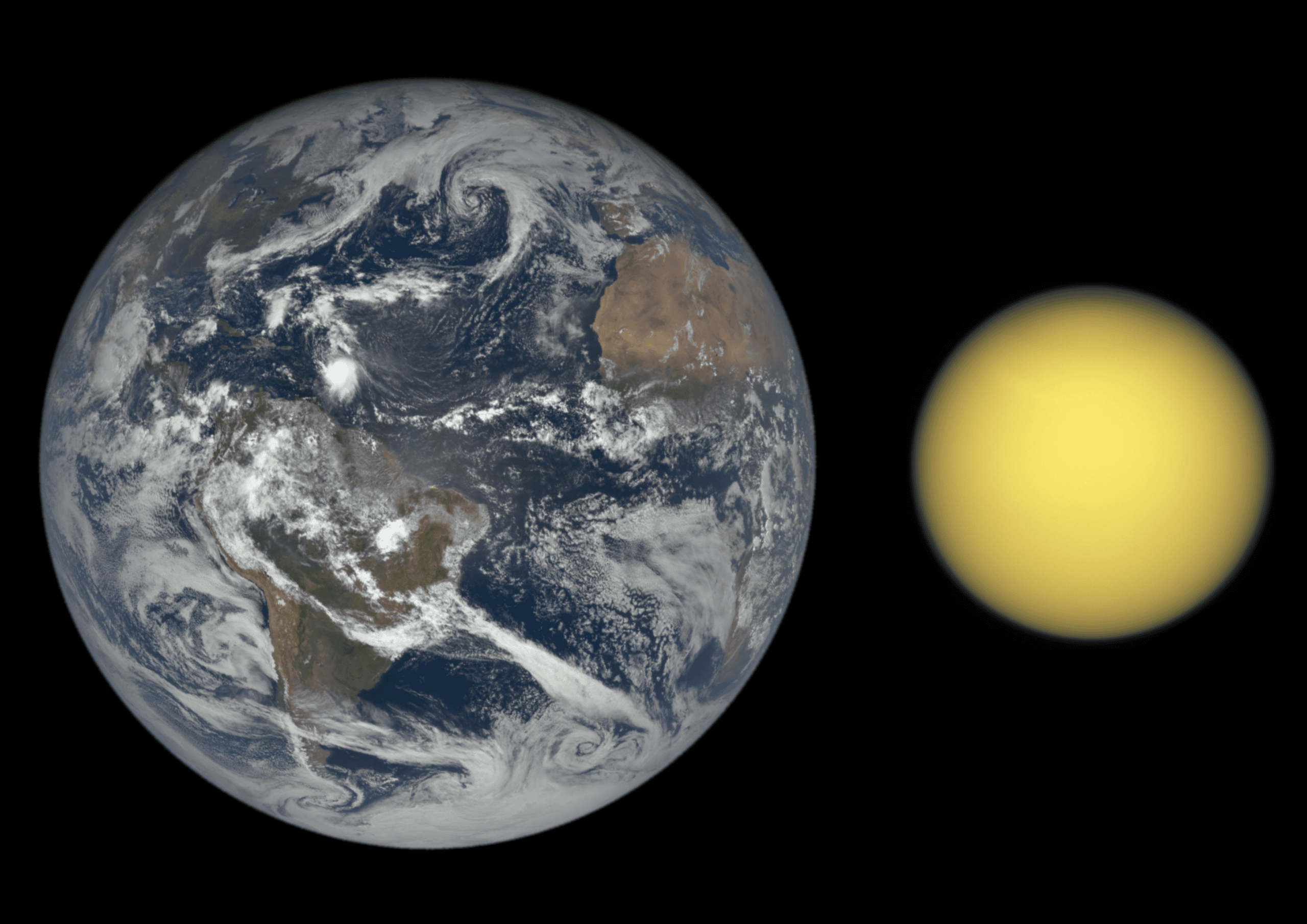
Earth image derived from DSCOVR/EPIC. Titan image derived from Cassini spacecraft narrow-angle camera (NAC). The relative sizes are calibrated using the known distances to each target at the time of image acquisition and the angular resolution of the respective instruments. Titan’s apparent size includes its extended atmospheric haze.
Why Titan?
Titan is the only moon in the solar system with a substantial atmosphere and the only world besides Earth known to maintain stable bodies of liquid on its surface, but Titan is fascinating because it basically substitutes hydrocarbons for Earth’s water cycle.
On Titan, methane evaporates, methane clouds form, rainfall occurs, rivers cut channels, and liquids collect in lakes and seas.
This is how water behaves on Earth, making the cycle familiar, despite being methane- and ethane-based.
Meanwhile, ultraviolet sunlight and energetic particles interact with atmospheric nitrogen and methane, which produce complicated organic compounds.
These compounds fall from the atmosphere, coating the surface in the orange-brown material described as tholins.
In all, this makes Titan a natural chemistry laboratory that scientists can study to determine what happens when carbon-rich chemistry operates for millennia in an atmosphere entirely different from Earth’s own.
Dragonfly’s Advanced Tech
Titan’s unique environment facilitates a unique approach to interplanetary exploration.
The Dragonfly mission is built around a car-sized drone with eight rotors.
Titan is especially accommodating to flight because its atmosphere is so dense, yet its surface gravity is only about 14 percent of Earth’s.
Between the atmospheric density and the light gravity, aerodynamic lift is easy to achieve. Engineers had the liberty to design something that could fly and cover relatively vast distances.
Compare this advantage to Mars exploration, where exploration modules crawl a few dozen kilometers on the surface over the course of years.
On Titan, easier mobility will allow scientists to compare different geological environments, rather than betting the entire multi-billion-dollar mission on one landing site.
Dragonfly will be able to land, conduct experiments, recharge, and then scout another destination—and then another.
But because Titan is about 1.4 billion kilometers from Earth, pilots cannot operate the drone via joystick. So the aircraft will have to perform much of its own navigation, hazard avoidance, and landing autonomously.
DraMS is Key
DraMS, or the Dragonfly Mass Spectrometer, will serve as one of Dragonfly’s key scientific instruments. Samples gathered from Titan’s surface will be delivered into the instrument for molecular analysis or mass spectrometry, allowing scientists to separate and identify molecules based on their mass-to-charge ratios.
The Dragonfly mission will focus on organic compounds and chemical pathways associated with prebiotic chemistry, and the DraMS instrument will facilitate this investigation.
Were scientists to find that Titan naturally produces increasingly sophisticated organic molecules, it would tell us something fundamental about how nature assembles life’s chemical ingredients. Accordingly, the mission has a lot of scientific weight riding on the outcome.
Basically, the mission tests whether complex organic chemistry is just a quirk distinct to Earth or a more common consequence of planetary physics.
If complicated prebiotic molecules happen to emerge readily on Titan, then the implications can apply beyond our Solar System.
The Tech Legacy
Aside from the science explored, Dragonfly could also serve as a new benchmark in how humans explore other planets.
Rovers transformed Mars exploration, but wheels impose obvious limitations.
Aerial vehicles, meanwhile, can bypass geological obstacles and cover much greater distances while surveying vast expanses of terrain.
Dragonfly will serve as the ultimate test of aerial exploration on another world, possibly setting a new standard for how humans explore. Dragonfly has a lot to prove, both in terms of science and technology, but to do so, it must first travel over one billion miles.
About the Author: Harrison Kass
Harrison Kass is a writer and attorney focused on national security, technology, and political culture. His work has appeared in Tablet, City Journal, The Hill, The Spectator, and The Cipher Brief. He holds a JD from the University of Oregon and a master’s in Global & Joint Program Studies from NYU. More at harrisonkass.com.